


Voyage Overview
Sailing across the North Atlantic, you will be immersed in the Arctic’s rugged beauty,
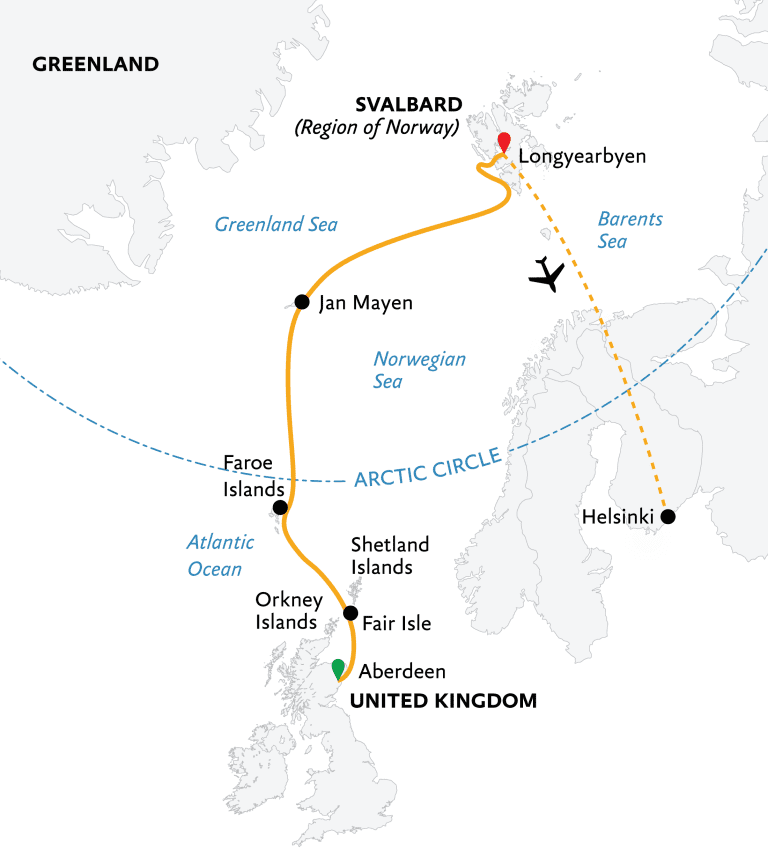
highlighted by visits to the awe-inspiring and unspoiled destinations of Fair Isle, the Faroe Islands, Jan Mayen and Spitsbergen.Ideal for first-time guests to the polar regions, Arctic Saga: Exploring Spitsbergen via the Faroes and Jan Mayen allows you to venture to some of the most remote islands on Earth, observe fascinating history and culture, and experience the dreamlike wonder of the midnight sun.
Prepare to be amazed by an environment different from anything you’ve ever witnessed, featuring immense fjords, towering glaciers, soaring sea stacks and coastal cliffs teeming with seabirds by the thousands. Observe reindeer, seals and whales in their natural habitat under a sunlit sky in the middle of the night.
Trip Details

Duration: 14 Days

Ship: Ultramarine, Premium Ship, 199 passengers

Start at: Aberdeen, Scotland
End at: Helsinki, Finland


Tour Dates
Itinerary
Day 1: Arrive in Aberdeen, United Kingdom
Arrive any time on Day 1 and make your way to your included hotel. The gateway for your Arctic adventure, the Scottish city of Aberdeen has many monikers, but its most famous is Granite City, as it was once the granite capital of the world. Wandering the streets, you’ll soon see why, as the Victorian buildings sparkle in the sun. A bustling cultural hub, Aberdeen also offers a range of museums, galleries, theaters, shops, cafés and restaurants to explore.
Day 2: Embarkation Day
Today you will have some free time before being transferred to the port to board your ship. As you set sail this afternoon, you’ll want to be out on deck, camera in hand—the area’s coastal waters offer excellent possibilities for spotting bottlenose and white-beaked dolphins, harbor porpoises and minke whales.
Day 3: Exploring Fair Isle
The U.K.’s most remote inhabited island, the extraordinary Fair Isle is located halfway between the Shetland and Orkney Islands. Boasting a rugged beauty, Fair Isle’s landscape is diverse, with fields and moors dominated by seaside cliffs and an astounding number of sea stacks, natural arches and caves. Despite its small size, the island offers activities for history, nature and photography buffs alike. Visit the museum to immerse yourself in local artifacts, photos, knitwear and other historic memorabilia. Don’t forget to snap a shot of the circa 1935 classic red phone booth by the post office! In terms of wildlife, orcas are native to the waters around Fair Isle, and they sometimes come close in pursuit of seals. But the island is best known for its coastal cliffs teeming with seabirds in spring and summer. The star attraction is the Atlantic puffin, a clown-like bird that burrows in nests in the grassy flat tops of the island’s cliffs. Photographers will surely want to capture pictures of their bemused expressions, and Fair Isle’s easily accessible grassy banks make it one of the best places in the Shetlands (if not the entire Scottish Isles!) to observe these colorful creatures. Northern fulmars, kittiwakes, storm petrels, razorbills and guillemots may be spotted soaring over the open waters. Visitors to this community of crofters, artisans and artists may be able to pick up a traditional Fair Isle sweater to keep warm during the rest of your Arctic voyage.
Days 4 and 5: Exploring the Faroe Islands
Known for its beautiful, unspoiled landscape, with verdant pastures giving way to rugged, steep cliffs, the Faroe Islands have a storied past, though the details of the archipelago’s early history remain mysterious. The first settlers may have been seventh-century Irish monks seeking solitude on these islands far removed from any continent. Their isolation ended in 800 AD, with the arrival of Norse farmers, and Norwegian colonization continued throughout the Viking Age. Today, many of the inhabitants of the Faroe Islands, now a self-governing country within the Kingdom of Denmark, are descendants of Norwegian Vikings, and speak Faroese, a descendant language of Old Norse. We will have two days to explore this seldom-visited archipelago made up of 18 rugged islands located about halfway between Scotland and Iceland. The mighty North Atlantic is omnipresent wherever we go with no place on the Faroe Islands farther than 3 miles (5 km) from its shores. The sea has always dominated life on the Faroes—throughout history as much as today: rich fisheries, magnificent ocean views and thriving sea bird colonies make up this rare Nordic jewel—often referred to as Europe’s best kept secret. We will spend a day exploring the outer islands of the archipelago, separated by narrow sounds and fjords, and delight in their surreal landscapes, dramatic cliffs, and rock formations. You’ll see green valleys engulfed by steep mountains, protecting picturesque villages with colorful turf-topped homes. Wind, weather and sea conditions will influence and shape our activity options, but we will of course always keep our eyes out for marine and bird life, especially the iconic Atlantic puffin. Our second day in the Faroes will be dedicated to the capital city of Tórshavn, where the Vikings established their government in 825 AD. One of the world’s smallest capitals, the picturesque Tórshavn has a relaxed vibe and a number of historical and cultural sites. Meander the maze of narrow laneways of the Old Town, admiring the quaint wooden houses with traditional sod roofs and white paned windows. If you’re looking for more action, a hike to historic Kirkjubøur not only unlocks some of the country’s best medieval history but also rewards with sweeping views over the southern islands of Koltur, Hestur & Sandur. Or perhaps you’ll prefer to wander the charming harbor, filled with cafés, pubs and old warehouses, and simply gaze out at the sea while sipping a latte.
Days 6 and 7: Cruising
Say goodbye to the Faroes as we cruise toward the world’s most northerly volcanic island, Jan Mayen. There are several activities to keep you engaged while at sea. Learn to identify seabirds gliding alongside your ship, attend dynamic presentations by your Expedition Team, relax in our polar library or simply spend some time on deck, admiring the ocean views. With your binoculars and camera at the ready, keep your eyes peeled for the blow of a humpback, blue or fin whale. Encounters with minke whales or orcas are also possible, since their curiosity can bring them near the ship. If you’re lucky, you may even see harp seals.
Days 8 and 9: Exploring Jan Mayen
North of the Arctic Circle, about 280 miles (450 km) east of Greenland and 340 miles (550 km) north of Iceland, the mysterious Jan Mayen rises from the depths of the North Atlantic Ocean. Often shrouded in thick fog, the small mountainous island was declared a nature reserve in 2010 and is rarely visited, save for the 18 rotating personnel of the Norwegian military and Norwegian Meteorological Institute, who are the only year-long inhabitants, save for some additional personnel during the summer. Landing here will be dictated by the weather and sea. If conditions allow, as we approach, keep watch on deck as the spoon-shaped island’s highest summit emerges. At 7,470 feet (2,277 meters) high, the breathtaking Beerenberg volcano features a symmetrical cone shape and impressive glaciers that spill into the sea. During the summer months, the island’s lower landscape is covered with grass, moss and a smattering of hardy flowers that add a burst of color to the otherwise barren black lava terrain. One site we hope to visit is Olonkinbyen and the surrounding area. Named after Russian-Norwegian polar explorer Gennady Olonkin, it’s the island’s only settlement and the location of the meteorological station, where you may have the chance to learn about polar research while seeing how weather is monitored at the top of the world. Another option might be the black sand beach at Kvalrossbukta, where the remnants of a 17th-century Dutch whaling station and a large northern fulmar colony can be found. In 1632, two Basque ships landed at the small bay and plundered the station. A Dutch party was sent here the following year to protect the land stations during winter, but all seven men perished from scurvy. Whaling in the area came to an end about 20 years later. If conditions permit, we may view the volcano and the stratified cliffs of the spectacular north coast as we Zodiac cruise around the island, searching for wildlife. Designated an Important Bird Area by BirdLife International for the large numbers of breeding seabirds, Jan Mayen supports colonies of northern fulmars, little auks, glaucous gulls, kittiwakes, and black and Brünnich’s guillemots (thick-billed murres). And if we are fortunate, you might see “sea parrots,” the Atlantic puffin again. The waters here are rich feeding grounds for marine life, so keep a lookout for minke, fin, blue or humpback whales.
Day 10: Cruising
As we sail farther north, spend some time with your shipmates in the lounge, swapping stories and photos, or take the opportunity to learn about the regions travelled with your experienced and knowledgeable Expedition Team.
Days 11 to 13: Exploring Spitsbergen, Svalbard
Rugged, wild and situated entirely within the Arctic Circle, the largest island of the Svalbard archipelago is unforgettable. From immense glaciers to lush tundra to polar deserts, the landscape here is as varied as the wildlife. As we explore the fjords of the southwestern corner of this magical island, it won’t take long for you to see firsthand why Spitsbergen is the “wildlife capital of the Arctic.” Some areas we hope to visit include Hornsund and Bellsund fjords and Hornbreen Glacier. The possible landing sites at Hornsund, the island’s most southerly fjord, have rich histories. You may visit Isbjornhamna, a bay at the entrance of the fjord, where we hope to explore colonies of delightful little auks. You may also spot Svalbard reindeer and hike to a viewpoint for views of calving glaciers. A 12-mile (20 km) long sound, Bellsund lured miners a century ago to its natural resources. Today, visitors come to Bourbonhamna and Calypsobyen to see historic mining and trapper sites and marvel at the magnificent vistas. It may also be possible to hike along the colorful tundra, dotted with flowers bursting for a taste of sunshine, and discover old whale bones.
Day 14: Disembark in Longyearbyen and Fly to Helsinki
The time has come to say farewell to your newfound friends and Expedition Team. After disembarking, spend the day exploring the frontier-style settlement of Longyearbyen before catching the charter flight to Helsinki.
EXPEDITION SPIRIT: Embracing the unexpected is part of the legacy—and excitement—of expedition travel. When traveling in extremely remote regions, your Expedition Team must consider the sea, ice and weather to guide the route and itinerary details. This itinerary is a tentative outline of what you may experience on this voyage; please be aware that no specific itinerary can be guaranteed. By the same token, wildlife encounters as described are expected, but not guaranteed. Your Expedition Team will use their considerable experience to seek out wildlife in known habitats, but the presence of any particular species of bird or marine wildlife is not guaranteed.
Trips & Rates
Please note, rates are Per Person in USD
Availability & prices are subject to change at anytime
Voyage Ship
Ultramarine
Ultramarine was designed to go beyond the familiar in polar exploration, to discover new places, and immerse you in the best the region has to offer. Equipped with two twin-engine helicopters, it offers the most robust portfolio of adventure activities in the industry, and features the category’s most spacious suites, breathtaking public spaces, and more outdoor wildlife viewing spaces than other expedition ships its size. Ultramarine also features a best-in-class operational range and an innovative mix of sustainability features that exceed all industry standards. With all this and more, Ultramarine is perfectly poised to deliver the ultimate polar expedition experience.

Ultramarine Cabins & Deck Plan

Ultra Suite

DECK 6
The most spacious and luxurious suite onboard the Ultramarine. Featuring a private bedroom with walk-in closet, sitting area with sofa bed, separate sitting area with table & chairs and a private balcony. The main bathroom has a shower, bathtub and heated floors. In the entrance hallway there is an additional powder room and walk in closet. Premium amenities include upgraded bedding, in suite coffee and binoculars on loan.

563 sq. ft. (52.3m2) + 46 sq. ft. (4.3m2) balcony

1-2

1 double or 2 single beds

Owner’s Suite
DECK 6
A large, luxurious suite featuring a private bedroom with walk in closet, full bathroom with shower, bathtub & heated floors, two separate living spaces and a private balcony. The main sitting area has a sofa bed, an additional closet and a separate powder room. Premium amenities include upgraded bedding, in suite coffee and binoculars on loan.
446 sq. ft. (41.4 m2) + 46 sq. ft. (4.3m2) balcony
1-2
1 double or 2 single beds

Penthouse Suite
DECK 7
The eight Penthouse Suites are the only cabins on Deck 7, allowing easy access to the Panorama Lounge & Gym. These suites offer spacious interiors, full bathrooms and generous balcony sizes. The sitting area has a sofa bed and the bathroom features a shower, bathtub and heated floors. Premium amenities include upgraded bedding and in suite coffee.
369 sq. ft. (34.3 m2) + 67 sq. ft. (6.2m2) balcony
1-2
1 double or 2 single beds

Terrace Suite
DECK 6
The two Terrance Suites are some of the most sought after cabins on the Ultramarine, thanks to the roomy interior space, extra-wide balcony (the largest balconies on the ship) and mid-ship location. The sitting area has a sofa bed and the bathroom features a shower, bathtub and heated floors. Premium amenities include upgraded bedding and in suite coffee. Early booking is highly recommended!
350 sq. ft. (32.5 m2) + 100 sq. ft. (9.3m2) balcony
1-2
1 double or 2 single beds

Deluxe Balcony Suite
DECK 4
DECK 6
The six Deluxe Balcony Suites area a great option for travelers looking for some extra space at a mid-range price. The suites feature a large living space with sofa bed, a substantial balcony and a full bathroom with shower, bathtub, enclosed toilet room and heated floors.
299 sq. ft. (27.8 m2) + 70 sq. ft. (6.5m2) balcony
1-2
1 double or 2 single beds

Balcony Suite
DECK 4
DECK 6
The Balcony Suite is the entry level balcony cabin on Ultramarine. Featuring a sitting area with sofa bed, private balcony and private bathroom with shower and heated floors. Some suites in this category offer interconnecting rooms. The balconies in suites 421, 422, 423, and 424 are partially enclosed.
226 sq. ft. (21 m2) + 52 sq. ft. (4.8m2) balcony
1-2
1 double or 2 single beds

Explorer Suite
DECK 3
Large entry-level double occupancy suites maximizing interior living space while still offering guests the opportunity to stay connected to the outdoors. Featuring a sitting area with sofa bed, picture window and a private bathroom with shower and heated floors. Suites 319 and 322 offer modified layouts and bathrooms for wheelchair accessibility.
285 sq. ft. (26.5 m2)
1-2
1 double or 2 single beds

Explorer Triple
DECK 3
The two Explorer Triple cabins are for solo passengers looking to share a cabin with other passengers of the same gender or 3 people traveling together. Featuring a sitting area, picture window and a private bathroom with shower and heated floors. Triple cabins typically fill up far in advance.
285 sq. ft. (26.5 m2)
1-3
3 single or 1 double + 1 single bed

Solo Panorama
DECK 6
For solo travelers who prefer to have their own cabin. The six Solo Panorama Suites are among the best solo cabins of any ship sailing in the polar waters as they offer floor to ceiling windows. Solo cabins also feature private bathrooms with showers and heated floors.
132 sq. ft. (12.3 m2)
1
1 single
Inclusions/Exclusions
Included in the trip package:
- Leadership throughout your voyage by our experienced Expedition Leaders, including shore landings and other activities
- All Zodiac transfers and cruising per the daily program
- All shore landings per the daily program
- Shipboard accommodation with daily housekeeping
- All meals, snacks, soft drinks and juices on board throughout your voyage (Please inform us of any dietary requirements as far in advance as possible. Unfortunately, the ships’ galleys cannot prepare kosher meals.)
- Free beer, standard wines, spirits, and cocktails during bar service hours and dinner
- Formal and informal presentations by our Expedition Team and guest speakers as scheduled
- A photographic journal documenting the expedition
- A pair of waterproof expedition boots on loan for landings and Zodiac cruising excursions
- An official expedition parka to keep
- Hair dryer and bathrobes in every cabin
- All miscellaneous service taxes and port charges throughout the program
- All luggage handling aboard the ship
- Emergency Evacuation insurance for all passengers to a maximum benefit of USD $500,000 per person
- Transfers between Longyearbyen town center and port on embarkation and disembarkation day
- Complimentary Wi-Fi service on one device permitting basic Internet browsing, email, posting on social media and voice applications. (Premium packages are available for more data intensive applications.)
Excluded in the trip package:
- International airfare
- Arrival and departure transfers, except where listed in the mandatory Transfer Package
- Passport and visa expenses
- Government arrival and departure taxes not mentioned above
- Meals ashore unless otherwise specified
- Baggage, cancellation, interruption and medical travel insurance—strongly recommended
- Excess-baggage fees on international flights
- Mandatory waterproof pants for Zodiac cruising, or any other gear not mentioned
- Laundry, bar and other personal charges unless specified
- Phone and Internet charges (connectivity may vary by location)
- Voluntary gratuity at the end of the voyage for shipboard staff and crew
- Additional overnight accommodation
- Adventure Options not listed in Included Activities
Note: A $15 USD per person per day gratuity for the crew is automatically added to your onboard account. It is at your discretion if you would like to remove the tip (or adjust the amount) when you settle your bill. It is not necessary to tip the expedition team members. This gratuity amount is included for suites as part of their ‘Suite Benefits’.
Adventure Options


Solo Travelers
Are you traveling alone? If willing to share a cabin, we can match you with another passenger of the same gender to avoid a single supplement.
Single occupancy price is 1.5x the per person share price.

